
It began at 9am on Thursday, 21 March, 2024.
Council officers were contacted on Thursday morning by local residents, Debbie Hunt and Graham Lovatt. This was what they saw:

An Arboricultural Officer visited that afternoon, inspected and spoke to the tree surgeon (who had left by then) and the Tree Preservation Order was drafted by 6pm on Thursday evening.
Thursday afternoon, Geoff Wakeling and Beth Keyes-Holloway, East Suffolk District Councillors, sent out a text message:
Developers are intending imminently to fell mature trees bordering the old Patrick Stead Hospital in Halesworth.
Right away, the alert was relayed to people attending the screening of The Motive and the Cue (an apposite title for this story) at The Cut. And onward it sped from there through networks of concerned local residents, especially those in the Bungay Road.
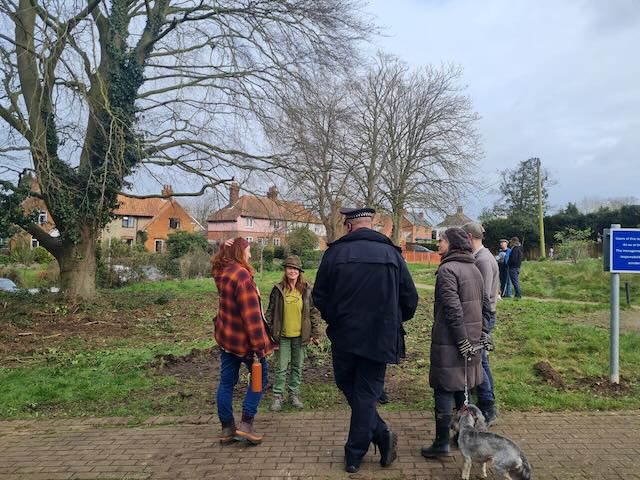
At 8.30 the next morning, Friday 22 March, a group began to gather at the site.
A police officer from the local Halesworth Community Police Team, who had been alerted first thing, proved to be a skilful go-between. He talked first with the site manager (/owner?), who said he had in fact asked the contracted tree surgeon to halt work yesterday, until clarity could be obtained regarding the remaining trees. (The Marron family now own the former hospital building and surrounding site, having bought it from the NHS.)
Local resident Debbie Hunt questioned this, saying the tree surgeon had been advised by a representative from East Suffolk Council yesterday not to continue, and had walked off site.
“Ah, we usually get many sides to the same story,” observed the Police Officer knowingly.
According to the site manager, the trees needed to be felled to make way for a larger and safer access road into the site together with pedestrian access. But Ms Hunt’s belief is that the developers see felling the trees as a cheaper fix than securing a boundary wall onto Bungay Road. “It’s our land, they are our trees and we can do what we like with them,” neighbours had been told.
An examination of the original Planning Permission documents for the development revealed that although preservation of the trees was defined within the original permission, the exact area the permission was granted for did not include the edge of the whole site. This is where several mature trees have stood for at least a hundred years.
The race was on. Could we get a TPO (Tree Preservation Order) in time?
Halesworth’s Green District Councillors had moved swiftly to get on the case, working with Suffolk County Council officers Richard Fox, and Falcon Saunders. The drafted TPO was reviewed over night and signed off first thing Friday morning. The trees were included for retention with protective fencing on the approved Arboricultural Method Statement on the planning permission but now with a TPO there is legislative protection.
With nearby residents, Debbie Hunt and Graham Lovatt, acting as 24-hour surveillance cameras, we felt safe to leave the site.
At 2pm same day, Friday 22 March, news came through. A Tree Preservation Order (TPO) had been granted on all the trees under threat and delivered to the owners of the site.
Geoff Wakeling said: “I’m THRILLED to report that we have managed to get a provisional Tree Protection Order (TPO) for the four trees at the front of the old Patrick Stead hospital. These include the three horse chestnuts and the large and beautiful copper beech. The TPO will last for 6 months provisionally, during which the council will deliberate on whether to make the order permanent.

**************
Video of the site. The voice over description is incorrect: 4 yews (not 2) on the pedestrian pathway, 1 magnificent copper beech (maybe planted at the same time as the one in Magnolia House), and the group of 3 trees near the entrance are 2 horse chestnut and 1 copper beech.
This story has strong parallels with Roger Deakins’ inspiring campaign to save Cowpasture Lane. Cowpasture Lane in Mellis, Suffolk, was partly destroyed in 1981 by a farmer who chopped down the trees lining the medieval drovers’ road but it was saved from obliteration by the writer Roger Deakin, who successfully battled to preserve it in the high court. (Granta exerpt of Roger Deakins’ writing)
This raises some important issues for the future of tree protection, and our trees need our protection, they are a vital and primal source of carbon sequestration in the growing climate crisis.
Much land is “banked” by prospective developers; having obtained planning permission, they wait – often many years – for a time when building work will be most profitable. This means that the planning permission they were originally granted is not as robust as it might be today. In particular, it is unlikely to take into account current legislation aimed at mitigating the effects of climate change, by protecting and promoting trees especially those ancients.
It is worth noting that this week’s crisis in Halesworth came to a head soon after another incident – the felling of a number of old oak trees along Harrisons Lane – which sparked considerable community anger. In this case, the developer Badger Homes claimed to be expanding a footpath to a new housing estate; they would mitigate mature tree loss by planting more new trees. However, as concerned residents have pointed out, an oak sapling is no substitute to a 300- year-oak, in terms of carbon, beauty, biodiversity, shade, air conditioner and so much more.
Today we have been relieved, and gratified, that the community and local council have been quick to jump into action to save those trees. But we wonder, would it not be better if council planners and regulators could instigate a 28-day ‘stay of execution’ notice on any tree deemed to be in jeopardy, while the arguments are looked into thoroughly and with less stress to all concerned?
How to protect other trees at risk?
The message needs to be, we CAN save trees! Please don’t just observe and mourn after the damage is done. Let your Green Councillors know; alert your friends and neighbours.
Halesworth’s Heritage Trees have been incorporated into Halesworth’s Neighbourhood Plan, but more can be added. Please report any trees you fear may be at risk; they may not necessarily be veteran or ancient. TPOs are being re-assessed in the area, and more could potentially be added. Together we can play a part in conserving and protecting the trees that play a vital part in our lives and in all our futures.





MAY 2024 UPDATE
Patrick Stead DC/24/1206/TPO
The above application is for the contentious Patrick Stead development site. Halesworth Town Council have submitted an objection to the application, this objection seems to be based on the concerns of the local residents and not from a health and safety or Arboricultural viewpoint.
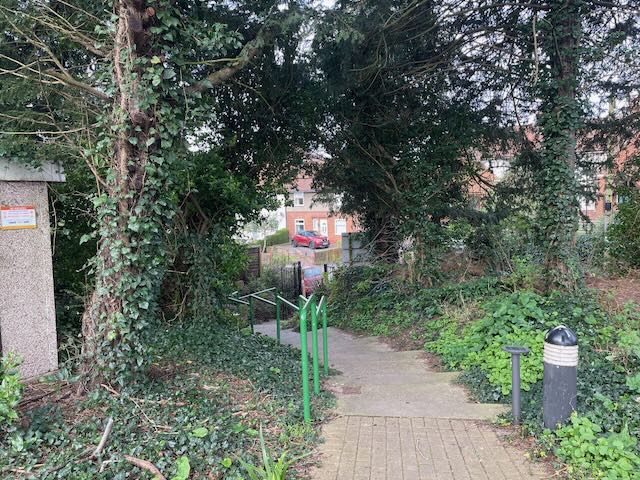
Richard Fox has been back to the site and concludes that the area would benefit from a crown raise of the four trees, some of the branches are low enough that pedestrians using the path will need to duck to avoid them. The proposal is to raise the crowns to 4.5m by means of pruning sub-lateral branches only, no main primary laterals will be affected by this approach, it is also good Arboricultural practice to raise the crown on all cardinal points to keep the crown balanced and aesthetically pleasing.
Richard Fox: “Trees (TPO trees included) in an urban environment will inevitably need some remedial works through time due to their surroundings and this is normally down to space and health and safety for the population. It is important to consider that the trees were saved from being felled and are now protected, we are now in control of the future of these trees. I feel that the proposed works are in accordance with good Arboricultural practices and are not likely to have a significant detrimental impact on the health or visual amenity of the trees.”