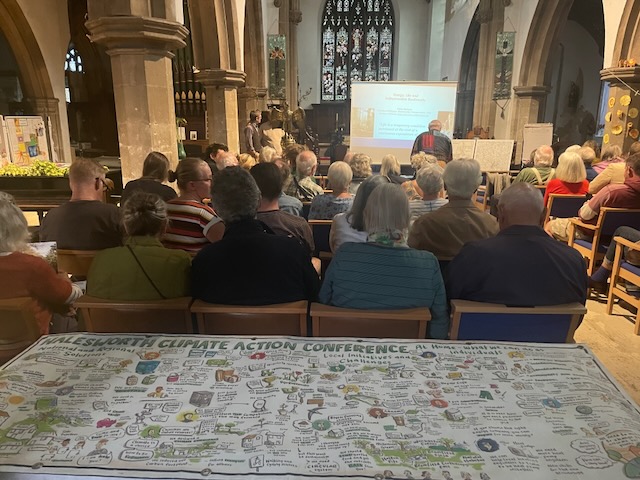
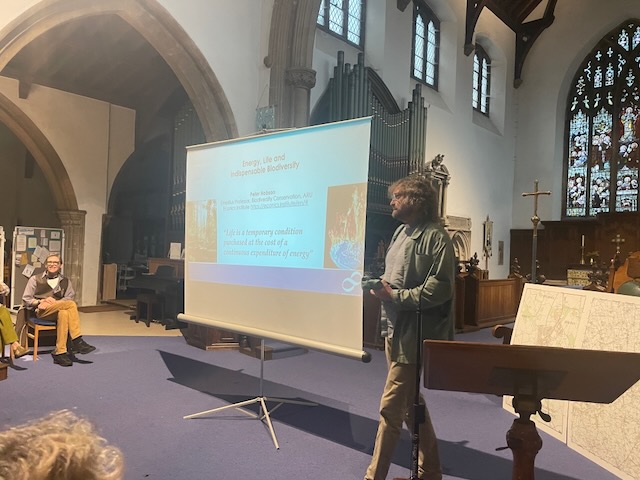
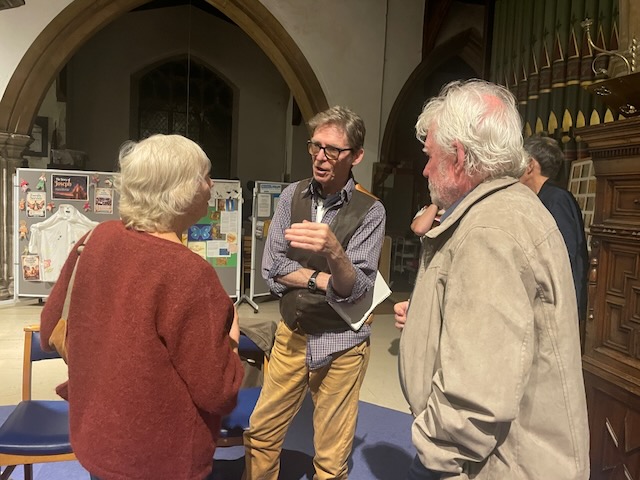
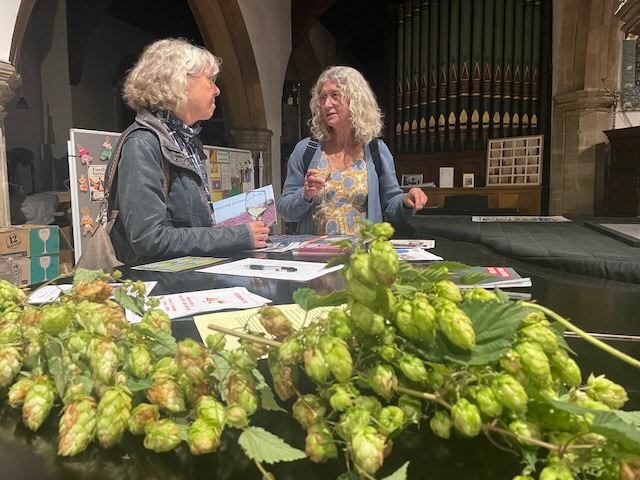
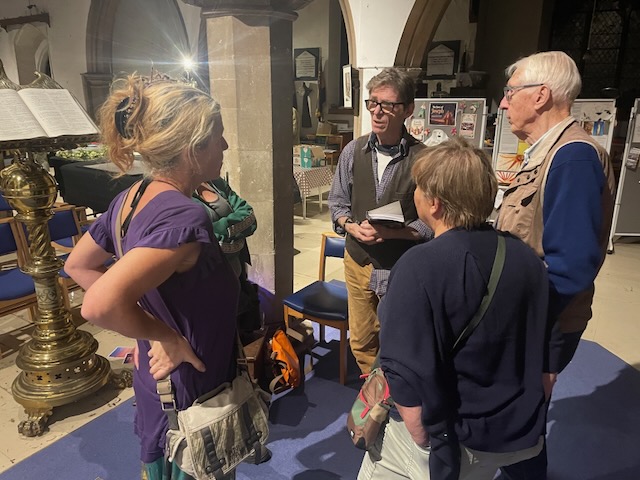
Peter certainly woke us up. We were back in our distant (for some of us) past dusting off our knowledge of entropy and the laws of thermodynamics.
All systems evolve through time and operate on basic laws of physics which we humans have categorised as the 1st 2nd and 3rd laws of thermodynamics. I had to remind myself of these laws (see end for definitions)
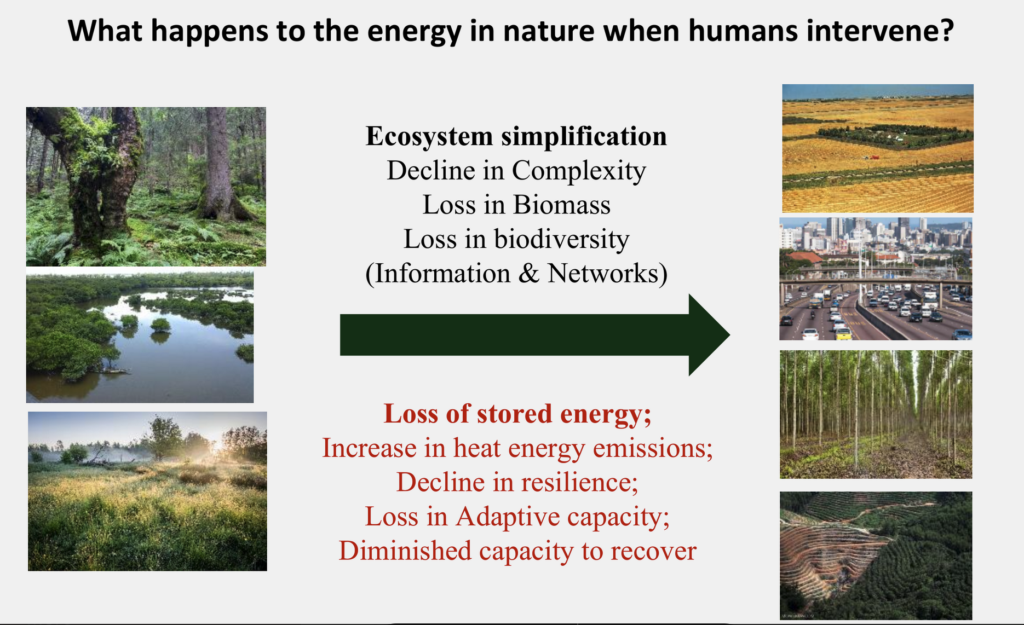
In other words we cannot do anything without repercussion. Lovelock (I never knew he was a NASA physicist) called this GAIA – earth as a wholistic cybernetic system with feedback tendencies. But his view was sidelined. Energy flows in the natural world. Within it biodiversity purchases energy and sustains the system with ever more complex systems. (For example the laying down of coal). It harnesses energy to build complex structures and networks to avoid Entropy (Chaos and Decay)
How energy is distributed in natural ecosystems – Biodiversity & Ecosystem Function
– Producers – Consumers – Decomposers
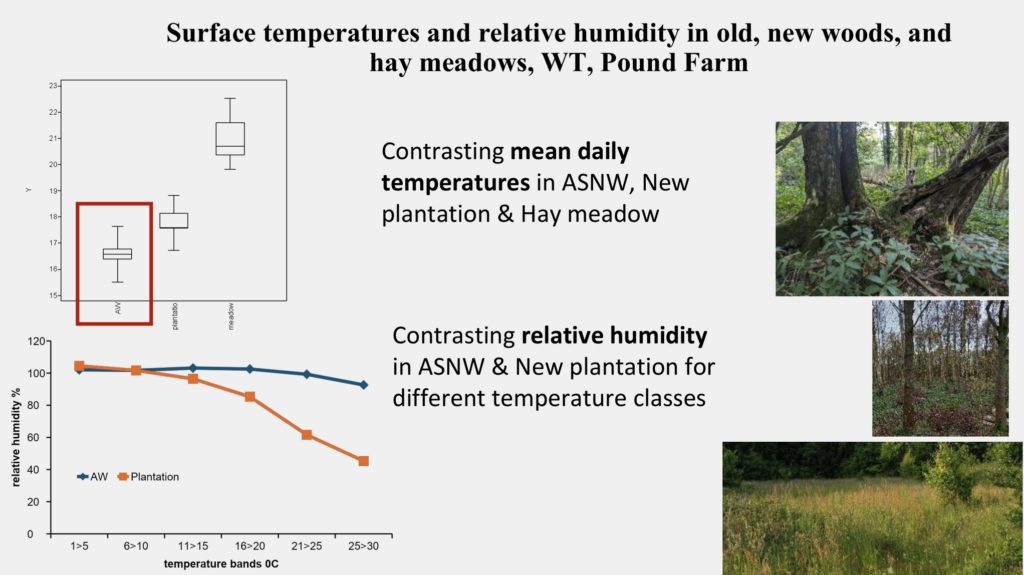
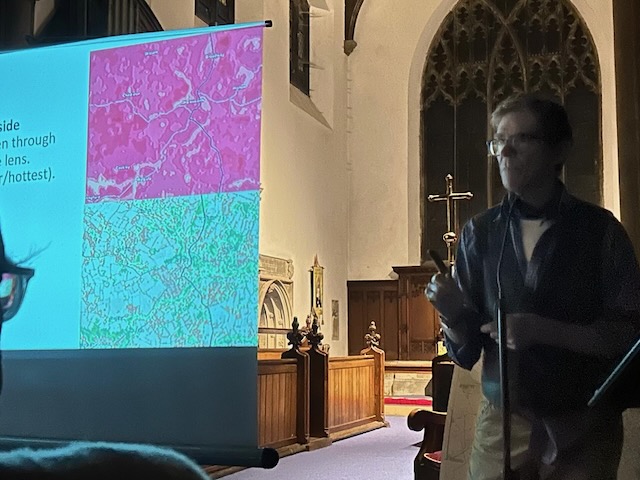
Using Pond Farm as an example of contrast between older more complex systems (ancient woodland 2-300 years old) compared to newer less complex systems (new woodland planted 1990). Contrasting mean daily temperatures and relative humidity, it is so much more consistent and greater in ancient woodland.
Likewise the importance of dead wood (stop tidying up woodland and burning it!) . More biomass = more water = lower temperature. Likewise soil with higher carbon content is cooler; contrasting organic and conventional cereal crop.
Enter human interference: Human exploitation leads to simplification of ecosystems: 7 of 9 planetary boundaries now breached. A small increase in global temperature or environmental stress triggers large, fast, and often irreversible changes to Earth’s systems.
What needs to change is our relationship with nature, or social logic. Below are some of the points to take away:
- Insects make up roughly 80% to 85% of all known animal species, representing the vast majority of Earth’s animal biodiversity. And of these 93 to 97% of insect species remain nameless.
- Dead wood matters
- Treat every system as complex. Spiders are as important as butterflies.
- We need to be adaptive in the face of climate change, rather than being too focused on mitigation. Learn how to adapt with our food and water systems,
- If we are going to turn this ship around we need radical transformative strategies.
- Don’t wait for the crisis to happen, be adaptive, be proactive, get in there, and, start looking at scenarios based on threat analysis. Ask yourself what do we do to divert ourselves away from ultimate entropy.
- Look to international examples of regenerative agriculture and close to nature forestry as we catch up locally.
Finally, be restful in yourself with all that you do not know.
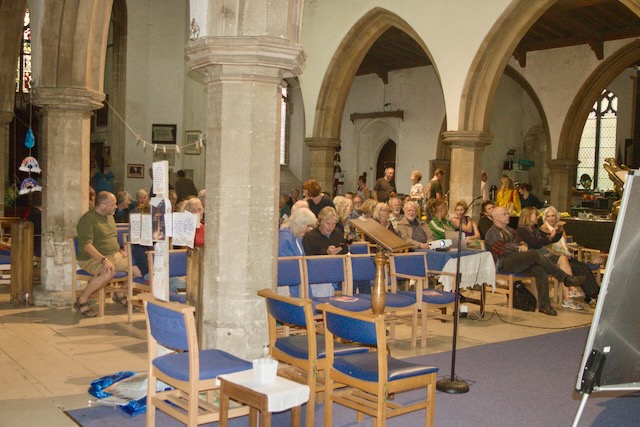
There followed an animated discussion on Peter’s challenge ‘Do not coppice in drought conditions’, and human interference in the context of the Dunwich fire: as a human created biodiverse system (albeit 200 years old) – should we humans continue to interfere and preserve it? A similar challenge from Beccles with their acid grassland. If left to nature all would become woodland. Peter – with his unusual knowledge of fires in Finland, suggested they left an area to see how nature restored itself.
Thanks to Dominic Doble for welcoming us to St Mary’s
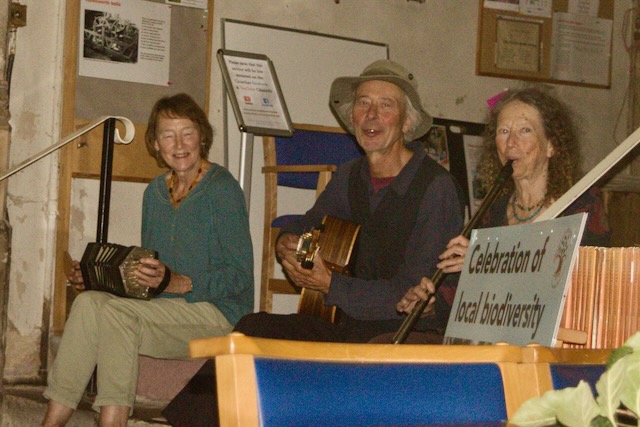
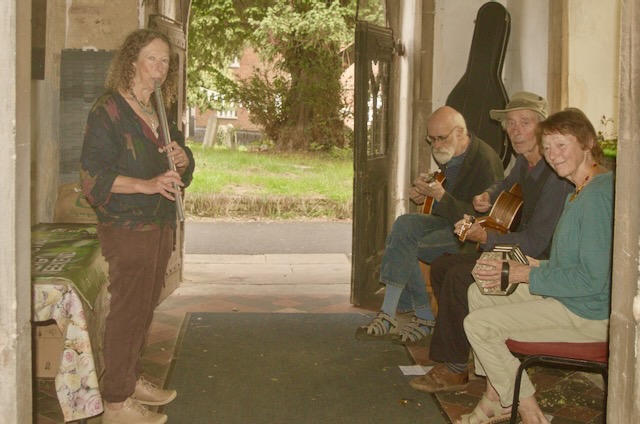
Thanks to Marion and the band for the music.
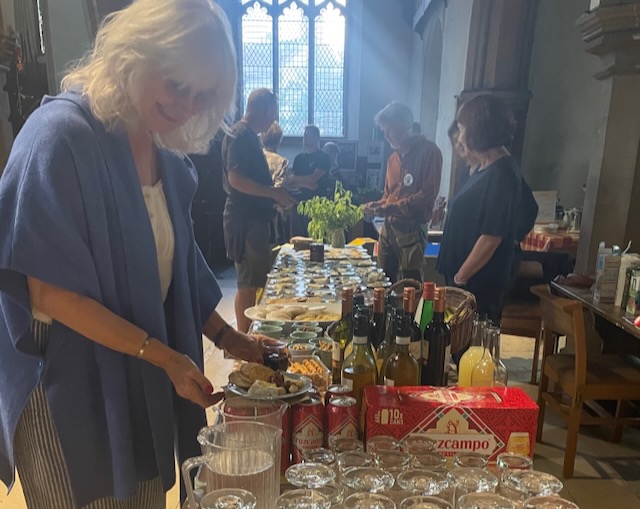
Thanks to Pippa and Edith for organising the food and drink Friday night and Saturday tea.
Thanks to Bacchus Beyond for the wine
.
.Postscript: Theomodynamics:
- The first law of thermodynamics states that energy cannot be created or destroyed, but can only be transferred or converted from one form to another
- The second law of thermodynamics states that the total entropy (decay/death/disorder) of an isolated system must increase over time meaning energy quality degrades. Entropy is a fundamental concept in physics and chemistry that measures the degree of disorder, randomness, or energy dispersion within a system
- The third law of thermodynamics states that as a system reaches absolute zero, its entropy (disorder) approaches zero.