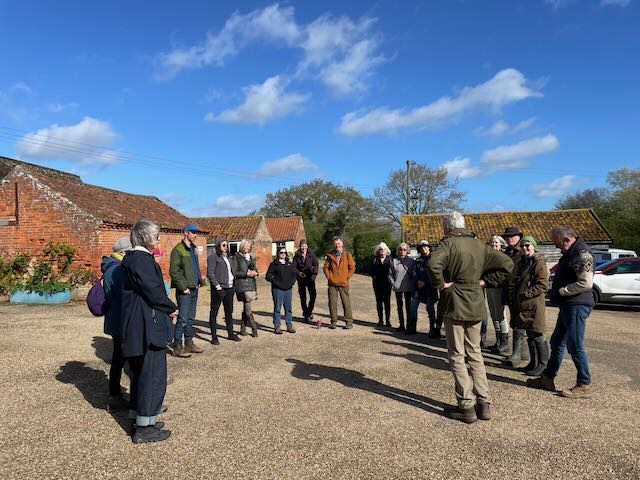
It was a glorious bright blue sky spring day – and not raining, as Richard said.
For nearly 50 years, Richard Symes had farmed this piece of Suffolk land and seen the changes. When he started there were 3 billion people on the earth, now it was 9 billion and the challenge of feeding people as well as sustaining nature balance was the theme of this day.
It’s a 400 acre arable farm, with a livery attached. A wind turbine contributes towards the energy and solar is about to join it, providing energy summer and winter. These days the arable work is contracted out. The method is a mix of hard nosed profitable farming but within conservation and regeneration principles. ‘We hhaven’t ploughed in years, with minimal soil disturbance’, said Richard. The land has not seen cattle since 1960’s. Part of the Natural England and Countryside Stewardship / nature conservation scheme. Part of the Blyth Cluster, created to join up like minded land owners for joint funding and shared experiences.
Historically it would have been wood pasture, on clay land (A12 divides the sand from the clay).
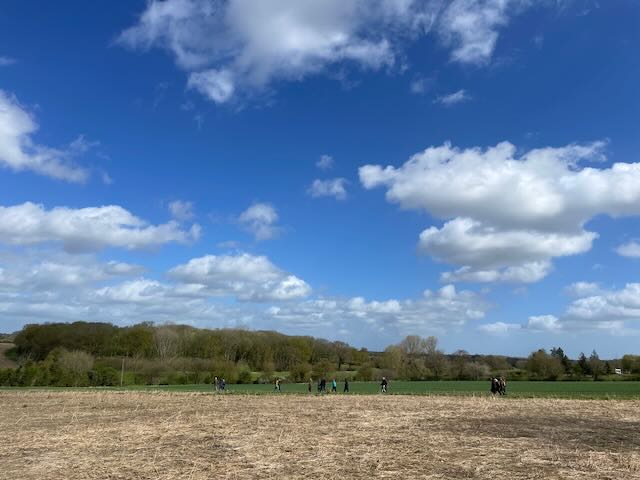
We walked along wide field margins, along permissive paths (created when in Europe, and continued post Brexit, as people had become familiar with such access). We looked across the gentle rolling valley, as Richard told us straight, the fields although not ploughed had had a light harrow, weeds sprayed off, and were about to be sown with peas or linseed. It was not ideal to have naked soil.
‘The carbon in the soil is more than all the carbon in vegetation AND all the carbon in the atmosphere’, Richard began and described 3 degrees of carbon capture in soil: the short term carbon near the surface, the medium term carbon, (5-6 years) and the long term carbon (1,000+ years)
Perennial cropping would make a huge difference with minimal disturbance of soil, which is permanently covered with a cover crop, then harrowed in before sowing main crop.
Ponds were what we were looking at and at the first one, came the story of the rare stonewort in 2019: The Slimy-fruited stonewort (Nitella capillaris), thought to be extinct since 1959, was found growing in clean, clear water in this arable field. Less common than newts, which were everywhere!
We moved to a field of sown with wild bird feeding crop – millet and grain, (easier on clay land than nectar rich crop) and here we heard the story of the 3 farms: Earlsway, and Brights, had both been in Countryside Stewardship scheme for 20 years. However the neighbouring farm, although similar in size and landscape, had no conservation methods implemented, the ponds had all silted up. When a new farmer took over the 3rd farm, a baseline study was done across all 3 farms: where 25 species of x were found across Earlsway and Bright, 3 were found in the unconserved farm: it was described as an ecological desert. The new farmer had ponds galore revived within the year.
Henry Dimbleby book ‘Ravenous’ – author of the National Food Strategy. UK had become very nature depleted, due to the drive to increase yields, we have sacrificed the biodiversity. 80% of food we eat comes from 20% of our agriculture land. An acre of wheat gives 4 tonnes of grain, which is mostly energy. An acre of grass for cattle gives 1/2 tonne of beef, and 90% of that is water.
Dimbleby concludes we need diverse systems:
- Intensive for basic food provision
Benign farming, regenerative
Organic farming – niche market - But best of all take as much land as possible out of farming. Like the Wendling Beck Environment project – WBEP is working in partnership with Natural England as a Biodiversity Net Gain pilot. 2,000 acres.
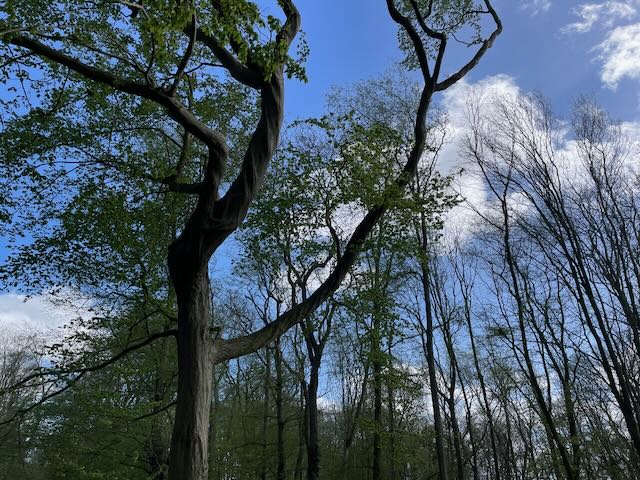
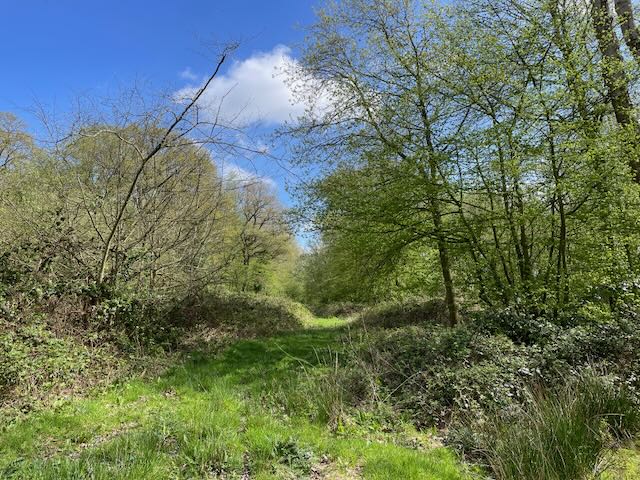
We entered the woodland – semi ancient, hornbeam coppice, with standards. Glorious twisted hornbeam (which makes it tough to work with but excellent fire wood). Coppice began 10 years ago, supplying wood energy for 2-3 homes. 5 shallow ponds, with southern edge coppiced to let in light, recently cleaned out by Crispin. The bramble season was coming to an end as the coppice began to grow and cut the light. ‘After coppicing, how to deal with bramble: go away for 10 years’, said Oliver Rackham. At the oldest hornbeam coppice area, Richard explained it had been coppiced the year of the 87 storm – cut by the storm itself. Then re-coppiced 20 years later (2007), when a carpet of foxgloves appeared, seeds dormant all these years.
Mud core data – would reveal the ages through pollen, the oldest being probably being lime (small leafed lime). Willow, the scourge of ponds, it turns out imperative for a certain dragon fly. A grass snake swam as if towards us. We ended at a row of 3 ponds, also recently restored by Crispin. Why 3? Probably used for retting . In Henry VIII time, with massive navel expansion, every farm had to produce a certain amount of rope and so grow hemp and needed to rot the cellulous off the stem to get the remaining cord.
Our last discussion was about balance, the need to weigh up our need to make a living, to grow food, with a sustainable farming practice. Richard started taking the treated sewage from the local sewage works – it was after all a perfect circular system. – until he was informed what was actually in the sewage, micro-plastics, hormones, heavy metals, etc. All of these could have a lasting detrimental effect on the soil. The causes and effects of copper sulphate, burning weeds or Glyphosate.
Oh those hares, racing across the field, 8 or 9 of them, zig zagging, one jumping.
Thank you Richard Symes for a fascinating window on to food, farming, soil and climate change.
Sebastiana and Rob were there to remind us of their up coming ‘Climate Conversations’ in June. Next event, Wakelyns Agroforestry in May.