Report from Wil Harvey
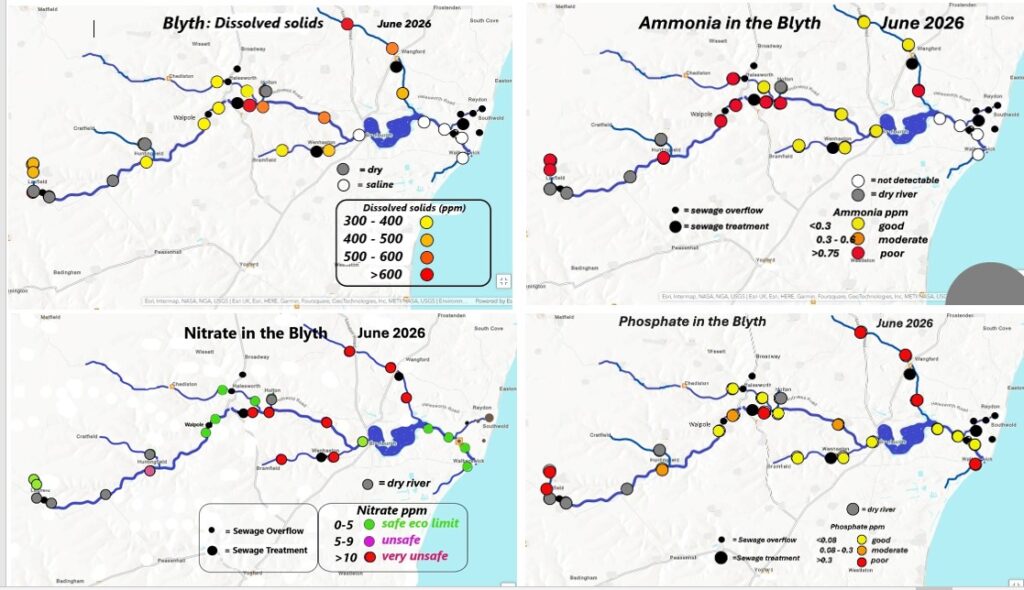
Here are the June 30th ‘heat-maps’ for our pollution results on the Blyth and tributaries.
The extended period of dry weather has caused the Blyth to dry up from its source at Laxfield right down to Heveningham. Most of the Huntingfield tributary and both the Huntingfield and Holton tributaries are also dry
Sadly, the pumping station CSO (sewage overflow) at Laxfield has continued to ‘spill’ periodically, leaving a lava-like flow of dried sewage on the dry river bed. Also concerning is that the records for this CSO show a total of 59 ‘maintenance events’ so far this year in addition to the spills. It is not clear whether there have been any spills during these maintenance events when the remote data recorders are switched off.
Worse, the pumping station CSO at Walpole, on the sewer main between Laxfield and Halesworth treatment works, is recorded as having 11 spills and 310 ‘maintenance events’ this year to date. Given these records, one has to question the fitness-for-purpose of these pumping stations and their associated pipework.
Our pollution tests on June 30th showed a similar pattern to the previous months: pronounced contamination downstream from each of the sewage treatment works on the non-tidal Blyth, and very concerning pollution from sources at Laxfield and upstream from Wangford on the river Wang. The only positive feature has been the elimination of phosphate contamination from the Halesworth and Wenhaston sewage treatment works (due to phosphate-stripping at the works).
As our monthly testing programme of the Blyth catchment progresses, it is giving us a much clearer overview of the pollution pattern, and is allowing us to put our case to the Environment Agency, and thereby to Anglian Water, to press for urgent remedial action.
Again, many thanks to our volunteer teams for their generous time and efforts!